Math 211
Calculus I
Syllabus, Fall semester 2025(-2026)
Calculus is the mathematics of change.
Any field that studies change can benefit from the vocabulary and the toolbox of calculus.
In the site banner...
A visualization of change: The Trift glacier in Switzerland has been retreating in response to climate change. An artist flew a drone with a strong LED and took long-exposure photographs to "paint" each blue line, which outlines the extent of the glacier in a previous year.
- How does a quantity change with respect to other quantitites on which it depends? E.g. the quantity of drug in a patient's bloodstream depends on the time after injection...
- What is the average rate of change and the instantaneous rate of change?
- For a trip, given a varying speed (rate of change of distance with time) how to calculate the total distance travelled?
These questions arise in physics, chemistry, biology, economics, psychology, engineering, medicine and other fields.
Catalog description
Concepts of calculus emphasizing applications in the natural and social sciences. Topics include differential calculus of one and two variables, integration, and differential equations. Prerequisites: three and one-half units of high school mathematics including trigonometry or Math 170.
Prerequisites, expanded:
- A C or better grade in Math 170 Functions, Data, and Models
- or grades of A or B in 4 years of high-school mathematics that includes algebra, geometry, trigonometry, and precalculus.
A score of 76% or above on the ALEKS Placement Exam is highly recommended. The exam can be taken multiple times, and modules are available to help you review / refresh / learn anew any gaps in your knowledge.
Precalculus material will be reviewed rapidly during the first two weeks. If you have any concerns about your readiness for this course, please converse with the instructor.
Completing the ALEKS Placement Exam (no matter what score you obtain) is worth 10 points (equivalent to one quiz) towards your quizzes and assessments grade.
Learning objectives
By the end of the course, students will be able to do the following:- Describe and manipulate linear, power, polynomial, trigonometric, exponential, logarithmic, piecewise, combined, composed, and (some) multivariable functions.
- Relate and use symbolic, graphical, numeric, and verbal representations of functions.
- Use differentiation, antidifferentiation, integration, and separable differentiable equations to solve pure and applied problems.
- Use technology to investigate, visualize, and solve calculus problems.
- Learn mathematics by reading, liistening, exploring, and conversing in an effective manner.
- Explain mathematical reasoning, orally and in writing.
Class meets MWF, noon-12:50 MWF in SC 107.
Labs are Thursdays:
- Lab 01, 11:00 am-12:15 in AD 21
- Lab 02,2:00 pm to 3:15 in UN 004
Prerequisite: A grade of C or higher in Math 170 (Functions, Data, Models), or B or better in 3 years of high-school mathematics, including precalculus or advanced math. An SAT math score of at least 600 or ACT math score of at least 26 is highly recommended. See also ALEKS test and recommended scores for Calculus.
Instructors
Lectures
 Professor Paul Meyer Reimer
Sci 011 · +1.574.535.7318 (ofc)
paulmr@goshen.edu ·
+1.574.533.3995 (cell)
I don't have fixed office hours. You are welcome to stop by my office (SC 011) any time!
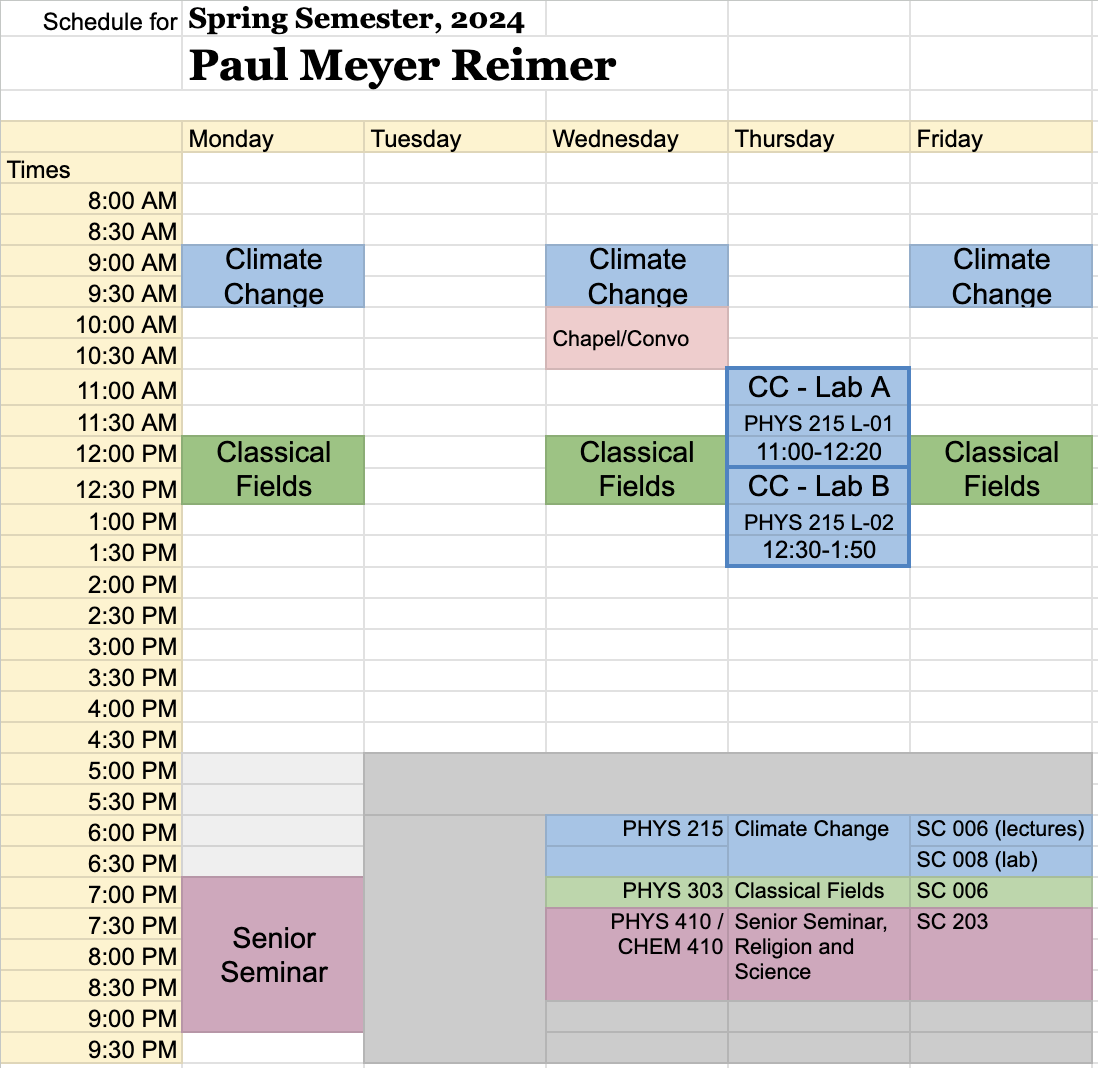
Do not worry that you're "bothering me" when you stop by! Every time a student stops by it makes a good impression on me!
The first time you text me, include your name! (Since all I'll see is your mobile number.)
Labs
 Assistant Professor Joey Lyon
Sci 104 · +1.574.535.7050 (ofc)
jalyon@goshen.edu
Teaching Assistant
 Nate Reeser, nathanhw@goshen.edu
Nate will be running the study sessions.
Course resources and materials
 Required:
We will be using Edfinity for homework assignments.
Required:
We will be using Edfinity for homework assignments.
__Purchase instructions will be available the first day of class__
To enroll please follow these steps:
- If you pay for your own books and supplies you can enroll in Edfinity directly, paying online by following the steps below.
- If you already have an Edfinity account from a previous course, please sign into it. Otherwise, start at step 2.
- Go to the following registration link: edfinity.com/join/XQY6CUAQ. You should see something like "Math 211 Calc I @ GC · Fall 2025".
- You will be prompted to pay (~\$33) and enroll in our section.
- Start working on your assignments :)
- If you receive financial aid for books and supplies from GC, Go to our GC Akademos site to purchase Edfinity access (~\$55). This is the only way to take advantage of your financial aid to purchase Edfinity access!
- If you pay for your own books and supplies you can enroll in Edfinity directly, paying online by following the steps below.
-
 Required:
Applied Calculus, by Deborah Hughes-Hallett, Patti Frazer Lock, et. al., 4th edition (Wiley, 2009).
ISBN 10: 0470170522 ISBN 13: 9780470170526.
(Paperback, at Alibris)
OB
Required:
Applied Calculus, by Deborah Hughes-Hallett, Patti Frazer Lock, et. al., 4th edition (Wiley, 2009).
ISBN 10: 0470170522 ISBN 13: 9780470170526.
(Paperback, at Alibris)
OB
The physics department has purchased used copies of this worthy textbook for our class. I will collect a deposit of \$8 each when distributing copies at the beginning of the term and return \$5 at the end of the term if you turn it in.2 copies should be available for short-term checkout on reserve at the Good Library front desk.
- Required - Offline, non-graphing, scientific calculator --or-- Desmos 'test mode' scientific calculator
For exams and quizzes you may not use a graphing calculator. A "scientific" calculator usually has trigonometric and logarithmic functions. For example, the TI-30X or Casio 260 are fine and run between $10-20.Or, you may use the Desmos scientific calculator in test-mode which prevents you from using other apps while you're in it.
- Binder: A one-inch three-ring binder with loose-leaf lined and graph paper is recommended so that you can keep printed copies of course resources and a written record of problem solving attempts, questions, math concept and technique discoveries, and skill assessments.
- We'll use several different computer graphing / calculation packages. Sign up for an account for each of these! Each of these services is free to you. (The Math department is picking up the cost of using CoCalc):
- CoCalc. It's important to use your Goshen College e-mail address as your username. Follow these instructions to sign up for an account on cocalc.com, and work through the instructions to Create your first notebook. We'll use Jupyter notebooks for most labs, which allow you to combine writing math (LaTeX and markdown) with calculations (SageMath) and data analysis (SageMath, R, much more...). Hey, you can use them for any other class in which you're doing calculations too!
- Desmos for exploring the graphs of functions of a single variable and fitting data to models. Make yourself an account. Then, work through this Intro to Desmos for graphing and data modelling.
- Geogebra for exploring graphs of functions of more than one variable.
- Class website: with a general schedule, course documents, lecture notes. Follow the link to an offcampus server maintained by Paul at 'raginmar.org'. I suggest that you bookmark that site!
On campus No username or password should be required to access course content.
Off campus You will be asked for access credentials if you're off-campus. The username is gcst*****. Paul will announce the password in class and post it on Moodle. - Gradebook: and some other course material on Moodle
- E-mail: read your @goshen.edu e-mail at least daily.
Class activities, attendance, study
An average student can expect to earn an average grade with 12-16 hours per week (including class and lab time). You will need to adjust this if you are not average, or desire a grade that is not average. See the math-dō page for concrete suggestions and considerations.
You are expected to attend class every day and to actively participate in class activities.
This year we have funding to run You are expected to come to class prepared. This means that you should have read the sections to be covered and should be prepared to ask questions about the reading and the problems you are asked to do.
You should be prepared to do problems and take part in class discussions and in class problem solving. Attendance in class and in the study sessions is reflected in the 'participation' part of your semester grade.
minimum grade outcomes: Grades are intended to reflect the degree to which the mathematical content has been mastered - not the performance of one student in relation to others.
Exhibit your ability to solve problems without assistance or collaboration.
If you score better on the final exam than your lowest semester exam, your final exam grade will replace your lowest semester exam grade.
Many Fridays there will be a five-minute closed book / closed notes
exercise to test your mastery of the material. There may also be
occasional reading quizzes given in class (no access to books) or
on-line ahead of class (access to the texbook allowed).
You will use technology and collaborate with others on more substantive
explorations in the lab. You will develop and refine your written communication skills through reports.
Achieve and exhibit understanding by completing the assigned exercises.
Homework in Edfinity will be assigned in nearly every class, and due by 7 PM after the following class, so that you have a chance to ask questions in the next class before it's due.
At least 2, and at most 3 assignments will be video homework, in which you record a video of yourself explaining an assigned homework problem.
Goshen College is committed to providing all students equitable access to programs and facilities. Students who need accommodations based on disability should contact the Academic Success Center (ASC). Students must register with the ASC before faculty are required to provide reasonable accommodations. For more information or to register, please contact the Director of Academic Success, Michelle Blank, Good Library 109H, mblank@goshen.edu or 574-535-7526. To ensure that learning needs are met, contact the ASC the first week of classes. More information at: goshen.edu/campuslife/asc/disability-services.
Academic dishonesty is any act that misrepresents your academic work or interferes with the academic work of others. Examples include, but are not limited to, the following: cheating, falsification of data, submission of your same or similar paper without professor consent, sabotaging the work of another, or plagiarism.
Plagiarism is the use of someone else’s ideas or words (sentences, clauses, or distinct phrases) without quotation or citation. If you have any questions about what constitutes plagiarism, please ask.
Cases of academic dishonesty are reported to the Associate Academic Dean, who oversees the Academic Integrity and Grievance policy. Penalties for academic dishonesty are listed in the college catalog and range from redoing the assignment to dismissal from the college.
I encourage you to collaborate with other students and seek
assistance from each other on the homework problems. Invite
others to join you in problem solving. Invite those who are
socially less connected to join you. Invite those who are socially more connected to join you.
You may also consult other resources / web pages / past students from this class / tutors. Answers to odd problems in the textbook are available in the back of the book.
Your goal is to be able to
explain to someone else how you solved each problem in each assignment.
For exams and quizzes, you may not use any resources unless a specific exception is stated by the instructor.
A variety of services are available through the Academic Success Center (ASC) to help students achieve their academic goals.
Monday 25 Thursday 28 Sunday 31 Monday 1 Tuesday 2 Friday 5 Friday 12 Thursday 18 Monday 29 Friday 3 Monday 13 Monday 20 Thursday 23 Wednesday 26 Thursday 4 Friday 5 Monday 8 Wednesday 10 Grading
homework / participation
15%
quizzes
10%
labs
16%
3 exams
39%
final exam (comprehensive)
20%
A/A- 93%/90
B+/B/B- 87%/83/80
C+/C/C- 77%/73/70
D+/D 67%/60
F < 60% Exams
Quizzes
Labs
Homework
Video homework (VHW)
Disability/ Accessibility Accommodations
Academic Integrity
Collaboration & Academic Integrity
Academic Assistance
Schedule & Topics
noon in Science 107
Classes begin
first labs, in AD 21
Study sessions start!
Labor Day, no class
Drop-Add deadline, 5 PM
Quiz 1 over Linear functions and Exponentials
Quiz 2 over Logarithms and Exp growth and decay
Exam 1 (in your lab session)
Community Engagement day, no class
Homecoming
Midterm break through Wed Oct 15
Academic advising begins
Exam 2 (during Labs)
Thanksgiving break through Fri Nov 28
Last day of classes
Please complete your course evaluations.
Exam 3 (During lab times)
Electronics Show, 1-3 PM, Science bldg
Reading day
Final exams through Wed Dec 10
& Math Department course questionnaire (collects your name, but goes to David Housman)
Final exam, 3:30 PM